


Page 56 - DAIS - DAISPORA ISSUE 05
P. 56
younger readers as well as older ones. My one rule for myself is to never How has the landscape of children's publish
condescend to my reader. I am not afraid to challenge them, whether it’s through since you first started writing, and what em
vocabulary or complex themes, because I know crafting a good story is the most excite you?
DAISPORA How did your experiences at DAIS shape your creative important thing. I started publishing in 2019, so not too lo
The first step of my writing process, especially for history, is to read as much as I
writing journey, particularly your path to becoming an
about publishing in India is that it is try
can. I read primary and secondary sources, keeping an eye out for interesting or
VOICES author? surprising anecdotes that I might want to include in my book. Then, I write the growing market for different kinds of genre
mediums like comics more. As a history writ
outline, followed by a first draft. Each draft usually goes through many, many
My two years at DAIS as an IB Diploma student profoundly shaped who I am
at historical fiction or comics about histor
iterations, which can be frustrating. But if you want to produce good writing,
today. I’d never before felt so intellectually challenged, or so pushed to think
critically and express myself with nuance. This gave me the skills and the you’ve got to keep editing and paring your words down until you find the perfect What advice would you give to our current s
Weaving Stories of History for Modern Readers confidence to pursue my passions—literature and history—at university and shape. might be interested in pursuing a career as
beyond.
The themes in children's books can be quite profound. Read a lot! A lot of students tell me they
Were there any specific teachers or classes during your What core messages do you try to communicate through don’t enjoy reading. You cannot be a good w
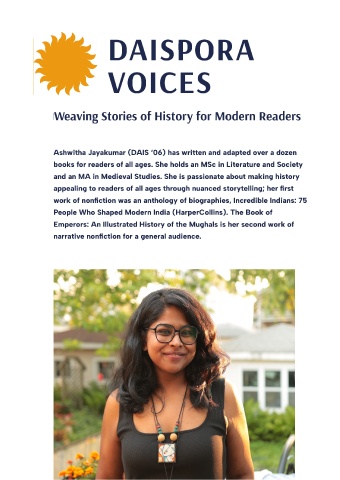
Ashwitha Jayakumar (DAIS ‘06) has written and adapted over a dozen time here that sparked your passion for storytelling or your stories, and why do you believe these are important across genres, across time periods and lang
books for readers of all ages. She holds an MSc in Literature and Society writing? for young readers? diary or journal, or even a blog – and don’
Good work takes time!
and an MA in Medieval Studies. She is passionate about making history Everyone has that one teacher they remember as the person who changed their In all my work, I want to explore the grey areas, to write about people in a way
appealing to readers of all ages through nuanced storytelling; her first life, and Tim Vallence, my English HL teacher, really did change mine. His that reflects the complexity of human beings in the real world, rather than black Many of our alums are now DAIS parents. Any
work of nonfiction was an anthology of biographies, Incredible Indians: 75 classes weren’t easy at all, and he expected a lot from his students. I am a far and white narratives that are simplistic. So that’s one core message that runs recommendations for what they should be rea
more careful reader and a more thoughtful writer thanks to his acerbic through all my writing — that you can’t neatly divide people into categories like
People Who Shaped Modern India (HarperCollins). The Book of
comments on my essays. I will always be grateful to him for teaching me to ‘heroes’ or ‘villains’. kids?
Emperors: An Illustrated History of the Mughals is her second work of never settle for anything less than excellence.
narrative nonfiction for a general audience. As a writer of history, my goal is to narrate the past with nuance and complexity, These are some of the books I’ve loved, one
without judgement. I am fascinated by the fact that people who lived a hundred
world and that have stayed with me.
What initially drew you to writing, and how did you or a thousand years ago weren’t that different from us today, and I try to find
transition from being a student to a published author? ways to emphasise this in my work.
I grew up reading history, but never the history of India. I read about WWII, the Dugga - Rajiv Eipe (Age 2+)
history of medieval Europe, North America and more, because there were
beautifully written and illustrated children’s books on these subjects, but none Wait - Antoinette Portis (Age 2+)
on Indian history. My only exposure to Indian history was through my textbooks, Farmhouse - Sophie Blackall (Age 3+)
which were uninspiring, to say the least. When I came back to India after my
second master’s and saw that there still weren’t many good books on Indian Queen of Ice - Devika Rangachari (Ag
history that could be read by young people, I decided to write one. His Dark Materials - Philip Pullman
I was in the industry already, so I understood the processes involved in pitching India After Gandhi - Ramachandra Guh
a book, working on a manuscript and seeing it through the production process.
That definitely helped make the transition easier. Midnight’s Children - Salman Rushdie
Can you describe your typical writing process? How do
you develop characters and storylines that resonate with
readers?
I think one of the pitfalls you can fall into as a writer is trying too hard to cater to
a single audience. I write for anyone — all of my books can be enjoyed by

